


Winning in Court, Losing Everything Else

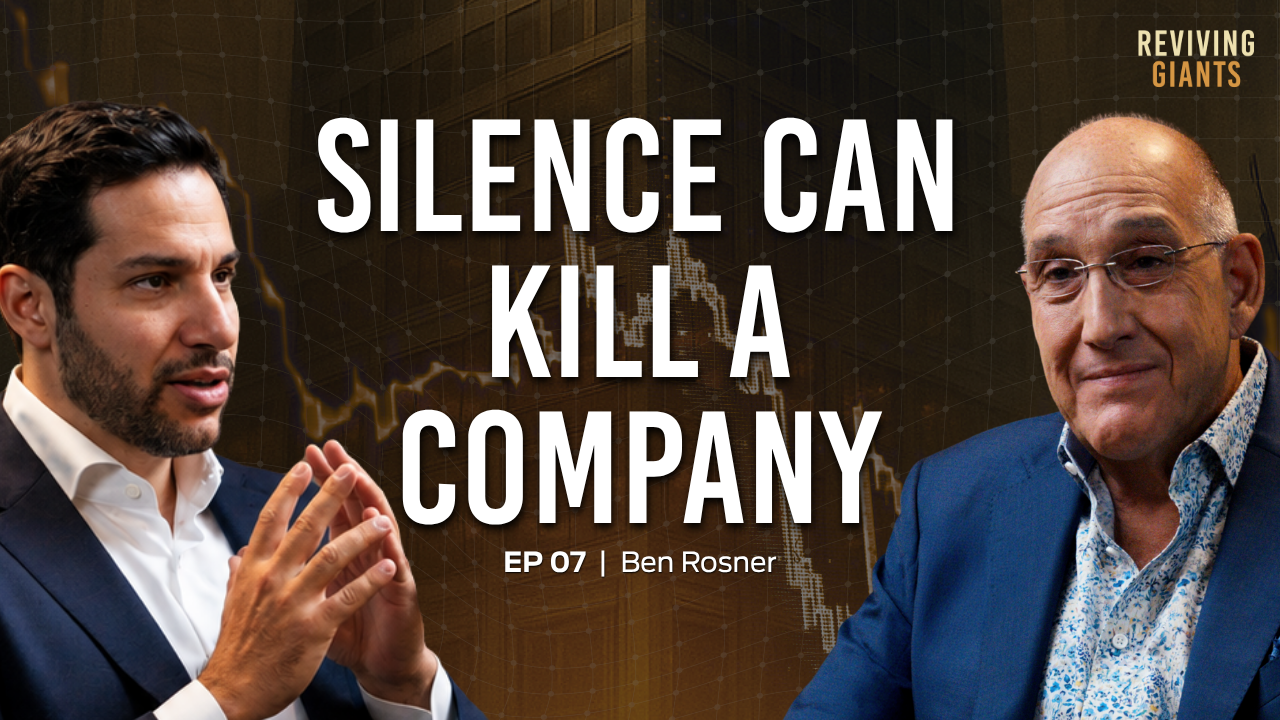
A company can win every legal battle in a crisis and still not survive it. That’s the uncomfortable truth at the center of a recent Reviving Giants conversation between host Drew McManigle and crisis communications advisor Ben Rosner, senior advisor at MACCO and founder of Anabasis Partners.
“There’s so often moments where companies can win legally but lose on the reputation front,” Rosner says. “What does it matter if you win in court if a few years down the line you don’t exist anymore?”
The News Cycle Doesn’t Exist Anymore
Rosner’s core argument is that the media environment companies are communicating into has fundamentally changed — and most crisis playbooks haven’t caught up.
“Reuters Institute came out with a report not too long ago, and they showed that 54% of Americans today get their news from social media,” he says.
The old approach — making sure a statement lands with the New York Times or the Wall Street Journal — no longer controls the narrative on its own. Rosner points to a real-time example from a World Cup match, where fan-recorded clips of a disputed call spread across social media and hardened public opinion before the game had even ended, well before any official statement was issued.
The Power Shift: Anonymous Accounts Now Break News
Rosner also points to the rise of anonymous finance meme accounts — Litquidity among them — as evidence of how far the balance of power has moved.
“It’s changed the power dynamic completely between traditional media and social media,” he says.
These accounts built enough trust with anonymous sources inside banks that outlets like the Financial Times began quoting them directly. A company’s crisis strategy that only accounts for traditional press coverage is, in Rosner’s view, no longer accounting for where the story actually breaks.
Silence Is Read as Guilt
Rosner is direct about what happens when companies choose not to respond — whether that choice comes from overwhelmed teams, fast-moving events, or legal counsel advising quiet.
“I think it’s widely accepted that today, not communicating and not commenting is just viewed by stakeholders as an admission of guilt,” he says.
McManigle agrees: “Saying ‘I don’t know’ or ‘I can’t say’ is not a good answer these days.”
Rosner is careful to note this isn’t an argument for saying anything untrue, or for ignoring legal exposure. It’s an argument that going quiet by default, without a deliberate communications strategy behind it, carries its own serious cost — one that’s often underweighted against the legal risk of speaking.
Activision Blizzard: The Cautionary Tale
Rosner’s clearest example of winning-the-battle-losing-the-war is video game company Activision Blizzard, which faced California regulatory action over alleged employee mistreatment.
Rather than engaging with the situation, Rosner says the company’s executive “responded incredibly aggressively,” calling the regulators “unaccountable bureaucrats.”
The fallout was severe. Employees walked out. Press coverage turned hostile. And the company “wiped 8 billion with a B in value from the market within days,” Rosner says — despite winning “every single case that came their way.” The company ultimately “lost its independence” and was acquired by Microsoft.
Rosner ties the example to a line from Justice Kennedy: that a lawyer’s responsibility doesn’t end at the courtroom door, but extends to protecting a client’s reputation whenever a legal proceeding threatens it.
The Same Math Applies to Restructuring
McManigle connects the point to a pattern he sees in liability management transactions — deals that rearrange debt and ownership without addressing why the company got into trouble in the first place.
Rosner adds a statistic he heard from a prominent restructuring lawyer at a recent TMA conference, made in reference to McManigle’s own frequent line that “it takes a lot of money to go broke.” Forty to fifty percent of LME transactions fail.
“To try to go through something like this, and you’re essentially flipping a coin if it works or not — that sounds to me like a really poor choice compared to actually trying to fix the company the right way,” Rosner says.
Takeaways For Leaders
-Winning a legal fight doesn’t guarantee the company survives it — reputation and enterprise value are separate battles
-More than half the public now gets news from social media — traditional-press-only strategies are outdated
-Anonymous accounts and social platforms can break news faster than official channels; plan for that reality
-Treat silence as a choice with a cost, not a safe default
-Address the underlying business problem, not just the capital structure — restructuring without fixing the business has a high failure rate
Listen to the Full Episode
Reviving Giants is presented by MACCO Group and hosted by Drew McManigle. To hear the full conversation with Ben Rosner on the changed media landscape, the Activision Blizzard fallout, and what’s at stake when companies get the narrative wrong, listen on the Reviving Giants page or wherever you get podcasts.
***
TL;DR
Companies can win every legal battle in a crisis and still lose their reputation, workforce, and independence. In a media environment where more than half the public gets news from social media, silence reads as guilt — and an aggressive, dismissive response can quickly destroy value that no courtroom win can restore.

.png)