


The War Room: Why Most Companies Aren't Ready for Crisis
A video can go viral in seconds. An allegation can spread faster than legal counsel can review it. And by the time most companies decide who is tasked with responding, the narrative has already been set. By someone else.
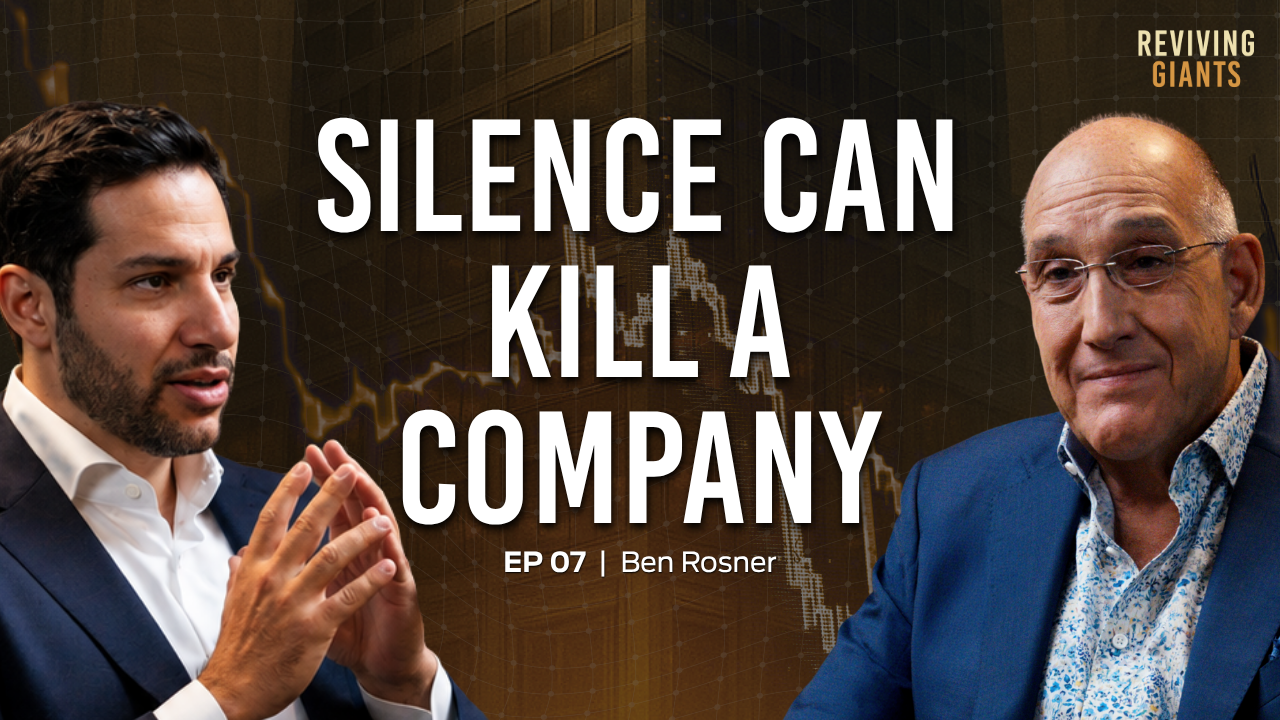
“I think the biggest one that I’ve seen that happens over and over again is that there simply isn’t the right infrastructure in place to deal and handle crises,” says Ben Rosner, senior advisor at MACCO and founder of Anabasis Partners, on the season two kickoff of Reviving Giants.
Rosner’s background spans corporate, military, and diplomatic communications — including a stint advising senior generals in the Israeli Defense Forces, up to the Chief of the General Staff. That range gives him an unusual vantage point on a problem he sees repeatedly in the corporate world: when an adverse event hits, there’s often no group of people already positioned to decide what happens next.
The Six-Person War Room
Rosner describes the working groups that handle crisis well as small and deliberately composed.
“The best working groups, sometimes they’re also called war rooms, that come together — they’re small. They’re typically around six people,” he says.
That group is usually built around the CEO and a COO or chief of staff — people who understand the business and can make fast decisions. Internal and external legal counsel sit at the table to flag legal exposure before anything is said publicly. And critically, Rosner includes dedicated crisis communications counsel, distinct from a company’s internal comms team.
His reasoning: internal communications staff may never have handled anything at this scale. “In the same way that founders go through an IPO, they might only do that one time,” he says. “Folks on the [internal comms team] might not have the experience necessary to deal with something as big as putting the entire company at risk.”
One Message Doesn’t Fit Every Stakeholder
Rosner and host Drew McManigle both point to a real example of what happens when that distinction gets missed: a WARN notice — the legally required notification of a mass layoff — that opened with a single salutation line addressed to “dear employees, workforce commission, and mayors.”
“These are completely different stakeholders,” Rosner says. “Each one cares about something else. Each one needs to know something else.”
Employees, vendors, creditors’ committees, and regulators are all operating from different levels of information and different sources of anxiety. A single generic notice may satisfy the legal requirement to notify, but it does nothing to manage how each group reacts.
Silence Creates a Vacuum
The most consistent theme in Rosner’s advising work is that not communicating is itself a decision — and usually the wrong one.
“When you don’t communicate, you create a vacuum,” he says. “And what happens is that other people fill that vacuum with their narrative instead of yours.”
That vacuum gets filled by employees, competitors, or the press — whoever moves first. Rosner notes that legal counsel sometimes recommends silence specifically to avoid creating exposure. But an unstaffed crisis response often produces the same silence by default, simply because no one owns the decision of what to say.
Vital Signs from A Midwest Hospital
Rosner points to a distressed Midwest hospital as an example of infrastructure functioning as intended. The hospital had shut down abruptly, and corporate counsel initially wanted to issue only a bare-bones legal WARN notice.
Rosner pushed back. The audience included doctors and nurses the hospital needed to retain through the shutdown — people who needed a reason to stay, not just a legal notification.
“There was great messaging, by the way, here,” he says. “There were great facts on the ground. They found what the issue was. They were actively fixing it.”
The revised notice, paired with a more human letter from the CEO, was picked up by media covering the story — and according to Rosner, it did more than shape public perception. It shaped the legal outcome. In a private settlement conference, the presiding judge referenced the coverage directly and expressed distrust of opposing counsel.
“That strengthened the negotiating position of the company and of legal counsel,” Rosner says.
Takeaways For Leaders
-Build a standing crisis working group before a crisis hits — not after
-Keep the group small: business decision-makers, legal counsel, and dedicated crisis communications counsel
-Don’t rely on internal comms alone for a company-threatening event — the experience gap matters
-Write separate messages for each stakeholder group rather than one generic notice
-Treat silence as a strategic choice with consequences, not a neutral default
Listen to the Full Episode
Reviving Giants is presented by MACCO Group and hosted by Drew McManigle. To hear the full conversation with Ben Rosner on crisis infrastructure, stakeholder communication, and leadership under pressure, listen on the Reviving Giants page or wherever you get podcasts.
***
TL;DR
Most companies don’t have a real infrastructure for handling a crisis — no small group empowered to make fast, coordinated decisions. Building a standing war room, tailoring messages to each stakeholder, and communicating early rather than staying silent can be the difference between managing a crisis and being defined by it.

.png)
