


We’re Not in Texas Anymore: Inside the 80s Oil Crash and Midland’s ‘Emerald Palace’
Texas in the early 1980s wasn’t just an oil downturn. It was the kind of collapse that reshaped careers, communities, and an entire industry.
In the latest episode of Reviving Giants, host Drew McManigle sits down with Berry Spears, a West Texas attorney who entered practice as the rig count collapsed, and Charlie Beckham, who found himself drawn into bankruptcy work as the downturn deepened and the bank failures began.
Together, the trio looks back at what it felt like in real time—rig counts collapsing, banks failing, FDIC interventions, and the hard lessons that helped shape modern restructuring work.
“Texas in the 80s wasn't just an oil crash,” says Drew. “It was a financial apocalypse. Banks collapsing overnight, rigs rusting in fields.”
When’s the Next Boom?
The defining theme of this episode is speed—how quickly “normal” disappeared.
“Between the time that I graduated from law school and took the bar and started, the rig count collapsed,” Berry says. “It went from 1,500 down to 150."
The emotional whiplash wasn’t just financial—it was existential. And not everyone saw the signs—until they hit the banks.
“There were indicators. We just didn't know about them,” Charlie says. “The indicators would flow through when the banks started failing.”
Once they started, failures came fast.
“National Bank of Odessa was the leading bank in the region lending to uh the oil field service industry,” Charlie says.
“And NBO failed,” he adds, with the First National Bank of Midland following suit two weeks later.
A Bank Run Isn’t a Metaphor
The lived reality of panic—what happens when institutions people assumed were untouchable suddenly aren’t--is all too real.
Berry remembers bank floors packed with people.
“Little old ladies had suitcases [and were] literally throwing them up on the counter and saying, ‘I want my money,’” he remembers.
“It was like what I always thought The Depression was like,” Berry adds. “And I thought, ‘Oh my God, it's coming.’”
Off to See the Wizard
As the downturn deepened, the FDIC became a daily presence in Midland—so much so that it earned its own shorthand.
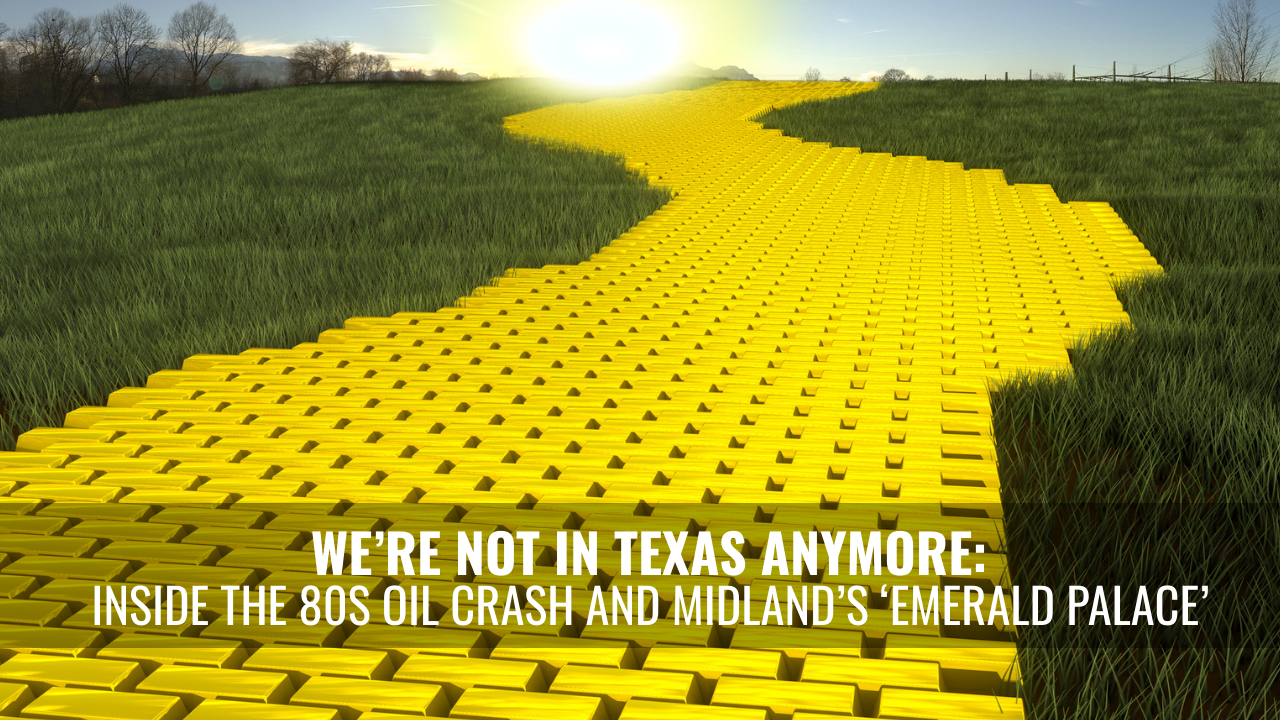
“We used to call it the Emerald Palace,” Drew recalls. “All the broke guys were going to meet, you know, the wizard--meaning all the collective FDIC guys. That's where we went.”
“The FDIC had close to 400 employees in that building,” Charlie says. “There was a popular T-Shirt that said ‘Midland, Home of the FDIC.’”
If you weren’t there, it’s hard to grasp how quickly the center of gravity shifted—from local relationships to federal intervention—almost overnight.
Payroll, Groceries, and a Lesson in Cash
In the midst of financial turmoil, employees and families still had to get through the week.
"The day the bank closed was Friday, and we had a payroll due. We had a yard full of mamas and children and crew members, and we still had eight or nine 10 rigs out in the field—and we can't make payroll.” Drew remembers. But his family's company did have charge accounts all over town.
“I told everyone, ‘If you need to buy some groceries or milk for the kids or whatever, come see me and we'll make arrangements and get you some groceries,’” he adds.
Drew was in his mid-20s at the time, navigating unimaginable circumstances surrounding his family’s oil field servicing company, and watching in real time as those circumstances shaped people, making them infinitely tougher.
The next morning, after a sleepless night, Drew watched as crew members showed up for duty.
“I just figured everybody would say, ‘Well, the hell with this,’ and not show up,” he remembers. “That's not what happened.”
“This one guy—bigger than I am today—with a hand like a bearpaw slapped me on the back of the head and said, ‘You'll figure it out, kid.’”
The Race to the Bottom—and the Careers It Built
The collapse didn’t just force bankruptcies. It changed behavior across the entire field—especially for operators trying to survive.
“Well, it was actually a race to the bottom, especially for any of the drilling companies. Because if you were trying to continue to operate outside of Chapter 11, you were still required to make your debt service, right? All your competitors started deciding, ‘Oh, gee, let's file Chapter 11. I can survive as long as I'm not having to pay debt service,’” Charlie explains. “Everyone had to chase the bottom, and it ended up causing so much pain and suffering in the industry.”
For some, though, the wreckage also became an education.
“When it all hit, with the rig count going down starting in April of 1982, is when I became a bankruptcy lawyer,” Charlie says.
Trust Was the Currency That Lasted
For all the chaos, one idea continued to resurface: in a distressed environment, trust becomes the most valuable asset in the room.
“It was a small community. You knew who you could trust. You knew who you couldn't trust,” Berry says.
“It all comes down to trust,” Charlie says. “Who can you trust? And that’s one of the great things about our profession. We learn over the years that there's a majority of folks you can trust. If they say they're going to do something, they will.”
Takeaways For Leaders
- Stability can disappear faster than the narrative admits.
- Bank and liquidity risk becomes real all at once—not gradually.
- In crisis, cash management becomes survival, not strategy.
- Trust is a real differentiator when the system is under stress.
Listen to the Full Episode
Reviving Giants is presented by MACCO Group and hosted by Drew McManigle, a veteran turnaround professional who brings decades of in-the-trenches restructuring experience to each conversation. To catch the entire conversation with Berry Spears and Charlie Beckham, listen to the full episode on the Reviving Giants podcast page (and wherever you get your podcasts).
.png)
